Subscribe to continue reading
Subscribe to get access to the rest of this post and other subscriber-only content.

Subscribe to get access to the rest of this post and other subscriber-only content.

Subscribe to get access to the rest of this post and other subscriber-only content.

Football season kicks off NEXT WEEK, and the countdown is on! Make sure your home entertainment setup is championship-ready before the big kick-off. Whether you’re hosting the big watch party or enjoying the games with family, Dunman Electric has the electrical solutions to transform your viewing experience so that you can cheer on your team (Even if it’s the Dallas Cowboys.)
Schedule ANY electrical service during the ENTIRE MONTH OF SEPTEMBER and get a flat $50 off TV mounting!
Plus, mention “KICKOFF” when you call to receive a FREE in-home assessment of your entertainment setup.
With the season starting next week, our schedule is filling up fast. Contact us TODAY to ensure your home is ready for every touchdown, field goal, and heart-stopping play!
(512) 280-8847 . becky@dunmanelectric.com . contact us
Dunman Electric is fully licensed, bonded, and insured. We serve Austin, Buda, Dripping Springs, Bastrop, Round Rock and surrounding areas.

We’re big fans of helping you beat the Texas heat. All month long, get $50 off any ceiling fan installation + with any service call in August, we’ll balance and check the direction of your existing fans for free!
It’s August in Texas, and the AC is doing most of the heavy lifting to keep your home livable. A ceiling fan can make the difference between feeling comfortable and sweating through the night, but only if it’s set up and running the right way.
In summer, ceiling fan blades should spin counterclockwise when viewed from below. This pushes air downward, creating a wind chill effect that makes you feel cooler, even though the actual room temperature hasn’t changed.
Quick check: stand under the fan. If you can feel a steady breeze hitting you, it’s turning the right way for summer. No breeze? Flip the direction switch on the motor housing.
A wobbling fan isn’t just noisy. It is slowly shaking itself apart. That vibration puts extra strain on the motor bearings, loosens blade screws, and can even cause wiring fatigue over time.
Common causes of imbalance include
• Dust buildup on one or more blades
• Loose blade or mounting screws
• Blade pitch slightly off between blades
Balancing the fan keeps it running smoothly, moves air more efficiently, and helps the motor last longer.
A fan motor should feel warm, not dangerously hot or give off a burnt smell. If it’s running hotter than normal, one or more of these may be happening:
• Overload: Worn bearings or unbalanced blades make the motor work harder, drawing more amps and generating more heat
• Poor ventilation: Dust inside the motor housing traps heat
• Voltage drop: Low voltage on an overloaded circuit forces the motor to work harder to maintain speed
• Insulation breakdown: For every ~18 °F the motor runs above its rated temperature, insulation life is roughly cut in half
If the motor housing is too hot to touch comfortably or you detect an electrical odor, that’s a sign of developing failure. Addressing it early can mean a quick fix instead of a full replacement.
Ceiling fans don’t reduce the ambient temperature of the air in a room. Instead, moving air speeds evaporation of sweat and increases heat loss from your skin, so you feel cooler.
That effect means you can raise your thermostat by around 4 °F while staying comfortable, which can reduce AC use by up to 30% during the cooling season. If nobody’s in the room, turn the fan off to conserve energy because it won’t have any cooling effect without someone there to feel it.
If your fan is more than 10 to 12 years old, still wobbles after balancing, or has a grinding motor noise, it’s often more cost effective to replace it than repair it. Newer fans often have better blade pitch, improved motor efficiency, and quieter operation.
Bottom line: In peak summer heat, a properly installed, balanced, and correctly set ceiling fan keeps you more comfortable, reduces strain on your AC, and prevents unnecessary wear on your equipment.
All through August:
• $50 off any ceiling fan installation
• Free balancing and blade direction check add on with any service call!
Whether you need a brand new fan installed or just want to make sure the ones you have are working at their best, we will make sure you’re set up for maximum comfort before the month is over.
Offer ends August 31. Book now to lock in your savings.
(512)280-8847 . becky@dunmanelectric.com . contact us
To stay up to date with our latest offers, check out our website at www.dunmanelectric.com

by Craig Dunman, Master Electrician
If your property includes a pool or spa, then by definition, it includes an electrical system. That system doesn’t just power the equipment—it supports safety, reliability, and performance. And while much of it is out of sight, it’s critical that it’s done right.
This isn’t optional work. It’s foundational.
These are two separate functions—and both are required for a compliant system.
Grounding directs stray electrical current safely into the earth. It’s a passive protection system that keeps components stable and helps faults clear properly.
Bonding connects all conductive components—metal ladders, pool railings, rebar, pump housings, even nearby fences—so they remain at the same electrical potential.
Without grounding, your system may fail to shut down during a fault.
Without bonding, minor differences in electrical potential can become noticeable at the user level—especially in and around water.
⚠️ Note: These are not interchangeable. LED systems require compatible fixtures, transformers, and housings. Retrofitting without checking compatibility is a common source of system issues.
Electrical code is what keeps everything operating safely—not just for now, but long-term. A code-compliant system ensures performance, protection, and peace of mind.
Here’s what every pool and spa setup should include:
We provide full-service electrical support for pools and spas, including:
We’re here to make sure your setup runs right—quietly, safely, and up to code. To schedule with us today, reach out through our contact form or give us a call.

by Craig Dunman, Master Electrician
Most people don’t think twice about their electrical system until something stops working—or worse, someone gets shocked or a fire starts. As a master electrician with decades of experience in the field, I can tell you this: the small safety devices in your home matter. And if you don’t understand how GFCIs and AFCIs work—or why they’re different, you’re not alone. Most homeowners don’t. That’s why I’m laying it out plainly. Here’s what you need to know to keep your home and, most importantly, your family safe.
GFCI stands for Ground Fault Circuit Interrupter. It’s a safety device designed to protect people from electric shock due to unintended current paths—specifically when electricity flows somewhere it shouldn’t, like through a conductive surface or a person.
Here’s what that means in practice:
The GFCI constantly monitors the flow of electrical current. Under normal conditions, the current flowing out through the hot (live) wire and back through the neutral wire should be equal. If there’s even a small difference—say, 5 milliamps—the GFCI cuts power in a fraction of a second. This prevents harm by stopping electricity from traveling through an unintended path, like through a wet countertop, a tool casing, or a person touching a grounded surface.
Modern code requires these in all wet or damp locations because moisture increases the risk of ground faults.
AFCI stands for Arc Fault Circuit Interrupter. This device is designed to prevent electrical fires caused by arcing—tiny, high-temperature sparks that can occur when wires are damaged, pinched, deteriorated, or loosely connected.
Arcs can form between two points of wiring that are not supposed to be touching, and they can happen behind walls, in cords, or anywhere connections are degraded. These arcs often generate intense heat without drawing enough current to trip a standard breaker. That’s why AFCIs were created.
The AFCI monitors the waveform of the current and detects irregularities characteristic of arc faults. When it senses this pattern, it cuts the power to stop the arc before it ignites surrounding materials like insulation or wood framing.
Some homes now use combination devices that offer both GFCI and AFCI protection—particularly in areas like laundry rooms, basements, and kitchens where both moisture and arcing risks exist.
| Function | GFCI | AFCI |
|---|---|---|
| Main Purpose | Protects people from shock | Prevents electrical fires |
| Detects | Ground faults (current leaking to ground) | Arc faults (damaged or sparking wires) |
| Typical Location | Near water (bathrooms, kitchens, outdoors) | In the breaker panel protecting bedroom/living area circuits |
| Visual Clue | Test and Reset buttons on outlet | Test button on breaker (in panel only) |
To keep it simple: GFCI protects people. AFCI protects buildings. You need both.
You should test every GFCI outlet in your home once a month. It takes less than 30 seconds, and it could save your life.
GFCIs can wear out over time. Just because the outlet still gives power doesn’t mean the safety function is still active. Test it to be sure.
This one requires a trip to your electrical panel. Here’s how to check it:
Some AFCI breakers run their own internal self-tests regularly. You might see the breaker flash or blink—this is normal. But if the breaker trips on its own during one of those checks, that means it detected a problem. Don’t just reset it. If an AFCI trips, especially more than once, it’s not a fluke—it’s catching something. You need a licensed electrician to evaluate the circuit.
Never ignore a breaker that won’t stay on. It’s trying to tell you something.
You don’t need us for every little thing, but here’s when you should pick up the phone:
A licensed electrician can run a quick test on your system and verify your protection. It’s fast, it’s not expensive, and it’s one of the best ways to reduce your risk of shock or fire.
If you’re not sure about your protection, we’re here to help. Give us a call or click here for our contact form, and we can come out and do an electrical inspection for you!
(512)280-8847 . becky@dunmanelectric.com . contact us
For more articles like this, check out our toolbox.

TEME #33973 | TECL #23045 | Licensed & Insured
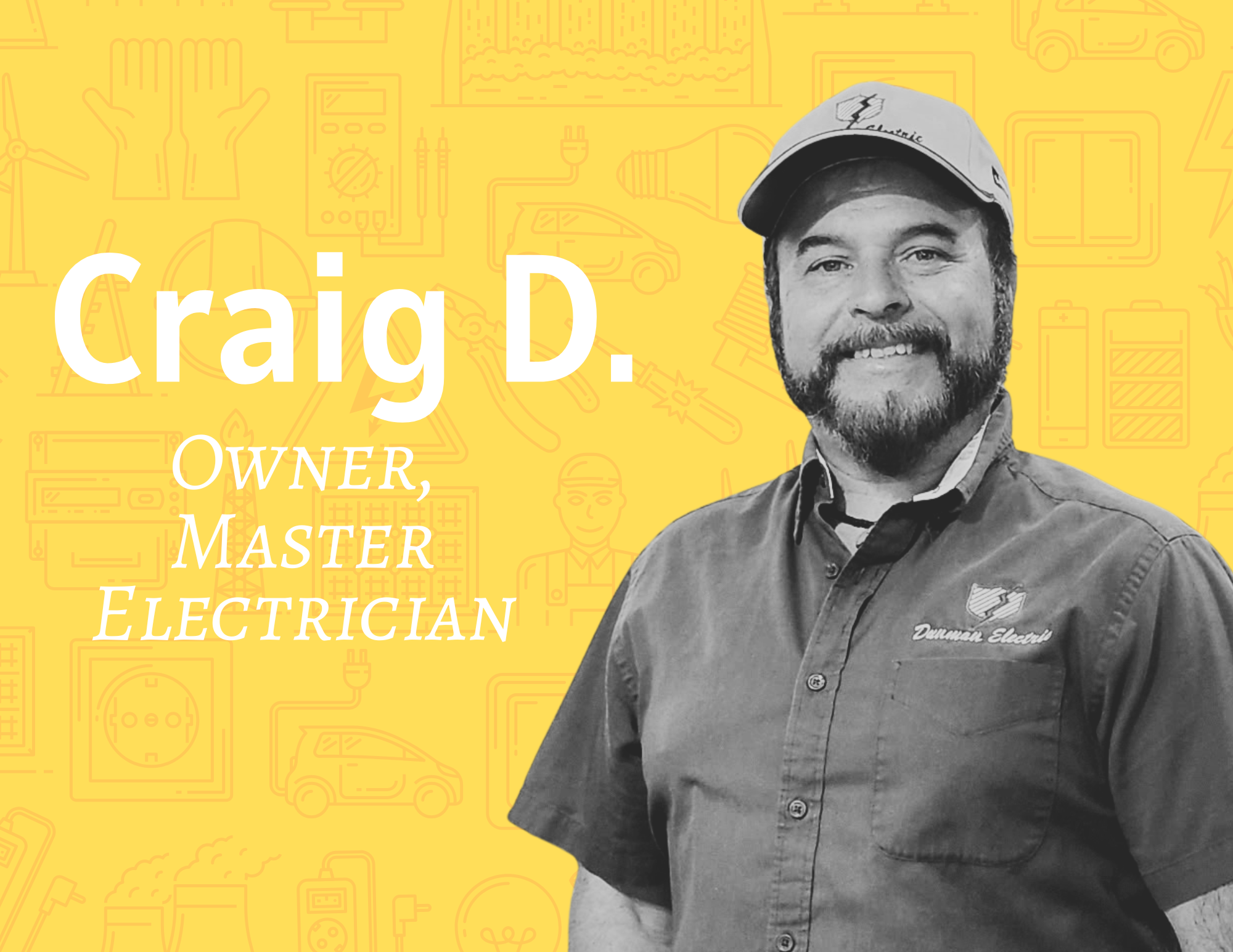
Craig Dunman was 22 when he first stepped into the electrical trade—and he’s never looked back. What started as a steady paycheck quickly became a lifelong passion. By 28, he had earned his master electrician license and knew he’d found his calling. “I’ve never worked another day since,” he says. “Electrical is play. It’s like therapy.”

In 1997, Craig and his wife Becky opened Dunman Electric with a simple mission: do good work, be fair, and treat people right. Nearly three decades later, they’re still at the helm—Craig in the field, Becky in the office—running the business the way they always have: hands-on, grounded, and rooted in trust.
But Craig isn’t defined by the job. He’s a lifelong doer who stays in motion. He plays ice hockey year-round, snowboards in the mountains any chance he gets, and scuba dives for fun. On land, he spends time trail riding with his horse, Nitro, or bass fishing from his Dunman Electric-branded bass boat.


He’s outdoors whenever possible, usually doing something active, physical, and off the beaten path.
Craig’s the kind of person who gets up early, keeps his gear in order, and knows how to use his hands—whether it’s fixing a wiring issue or tightening the cinch on a saddle. He doesn’t sit still well, doesn’t talk himself up, and doesn’t take shortcuts. What he builds—on the job or off—is meant to last.
He and Becky have been married since 1994 and raised three kids together: Lo, Cody, and Abbie. Their life has always been full of tools, laughter, projects, and movement. Craig isn’t just the guy behind the name—he’s the real thing. A master electrician, yes—but also a rider, a dad, a teammate, and someone who genuinely loves the work he does.

To find out more about our team members, click here. To see what services we offer, click here. To schedule with us, give us a call at (512)280-8847 or go to our contact us page. We look forward to hearing from you, and hope you have a happy weekend!

TEJE#477529
Wes S. grew up in Arlington, Tennessee, and now lives in the Austin area with his wife, their young daughter, and two rescue dogs, Katie and Raya. He brings a laid-back attitude and easygoing presence to everything he does, with family life at the center of it all.
Outside of work, Wes is usually chasing adventure or laughter. He’s a longtime snowboarder and an enthusiastic indoor rock climber- always up for a challenge if it means having fun along the way. His humor, curiosity, and steady energy make him a welcome presence wherever he goes.
Wes and his wife are active members of their church, Glad Tidings Church in Leander, and work as part of the sound and media team there. Whether he’s serving behind the scenes, playing with his daughter, or connecting with coworkers, Wes brings kindness, enthusiasm, and a genuine sense of connection to the people around him.

Loved your service with Wes? Leave us a Google review and mention Wes by name—technicians with standout reviews are eligible for bonuses!

⚡ POWER + PROTECT PROMO — Through July 2025⚡
The Texas power grid isn’t just unreliable — it’s become a liability. Anyone who lived through the 2021 Winter Storm Uri, the rolling blackouts of February 2022, or last year’s June ERCOT emergency notices knows this firsthand. The infrastructure simply can’t handle demand spikes or severe weather. That means high winds, lightning, power surges, and unexpected outages — year after year.
So let’s talk about what actually keeps your home running when the grid gives out:
Automatic transfer, manual transfer, and portable generators — and the one thing nearly everyone forgets: whole-home surge protection.
What they are:
A hardwired backup generator that requires you to start it manually and flip a transfer switch to power certain parts of your home.
How it works:
These run on propane, diesel, gasoline (in very specific installs), or natural gas and are installed outside the home. When the utility power fails, you physically start the generator and activate the manual transfer switch, which reroutes power to a secondary panel. Only the circuits wired to that panel will come online — usually essentials like lights, fridge, freezer, and maybe a few outlets or your HVAC (if it’s sized right).
Best for:
Homeowners who want dependable backup without the higher cost of an automatic system, and who don’t mind going outside when the weather gets bad.
What they are:
A fully automated backup system that detects outages and powers your home within seconds — even if you’re not there.
How it works:
The generator is connected to your natural gas or propane line and wired into your main service panel. When the grid fails, the automatic transfer switch (ATS) kicks in and reroutes your entire home’s power through the generator. When power is restored, it flips back to the utility feed, all without you lifting a finger.
Best for:
Homeowners who want uninterrupted power during storms or blackouts — especially those with freezers, medical equipment, sensitive electronics, or small children. These are also ideal for work-from-home setups where downtime costs money.
What they are:
Small gas-powered generators that you can roll out and connect to your home with a properly installed inlet box and interlock kit.
How it works:
You manually start the generator and plug it into a designated outdoor inlet. From there, you flip specific breakers to transfer power to essential circuits. It’s not a whole-home solution, but it’s enough to run the basics if properly installed.
⚠️ Critical Safety Warning:⚠️
A generator should only be connected through a dedicated outdoor inlet box, with a panel interlock or manual transfer switch installed by a licensed, bonded, and insured electrical contractor. This ensures your main breaker is disabled while the generator is live, preventing dangerous backfeed into the grid. Installing any generator power source without an appropriate interlock kit is illegal, violates the National Electrical Code, and can energize utility lines, potentially killing linemen working to restore power.
Best for:
Budget-conscious households that still want to avoid being completely in the dark during a storm.
Backup power is only half the equation. What most people don’t realize is that power restoration events, lightning strikes, and utility grid fluctuations can fry electronics long before the lights go out.
What it is:
A whole-home surge protector is a panel-mounted device that intercepts high-voltage spikes before they hit your circuits. These surges can be caused by lightning, utility switching, or damaged transmission lines.
What it protects:
Everything downstream — including your refrigerator, HVAC, smart TVs, computers, EV chargers, solar inverters, pool equipment, and security systems. If it’s plugged in, it’s at risk.
Fact:
Surge damage is not covered by most warranties. And those $15 power strips? They don’t cut it. You need layered defense:
If you’ve ever:
…you probably needed this yesterday.
We install manual, automatic, and portable quick-connect generator systems. We also retrofit homes for surge protection, check panels for age and load issues, and walk homeowners through real risk scenarios — not hypotheticals.
If you want:
Right now, we’re offering a bundled, Texas-sized storm special:
plus
That’s full protection — backup power + surge defense — in one package, installed by licensed professionals who do it right the first time.
Questions? Ready for a site walk?
We’re licensed, local, and don’t push what you don’t need. We’ll tell you if your panel’s fine, if your wiring is outdated, or if there are any code-compliance updates you need to know about! No guesswork. No scare tactics. Just real answers.
Call (512)280-8847 or reach out to us through our Contact Us page to schedule today and receive your free estimate and POWER + PROTECT Texas Storm Bundle!
| Term | Definition |
| Generator | A machine that converts fuel into electrical power. |
| Manual Transfer Switch | A switch you operate by hand to shift power from the grid to your generator. |
| Automatic Transfer Switch (ATS) | A smart switch that detects outages and switches power automatically. |
| Portable Generator | A movable, gas-powered generator used for temporary backup power. |
| Quick-Connect Kit | A code-compliant inlet and breaker system to safely connect a portable generator. |
| Whole-Home Surge Protector | A panel-mounted device that blocks dangerous voltage spikes before they reach appliances. |
| Voltage Surge | A spike in electrical voltage that can damage or destroy electronics. |
| Backfeeding | When power flows the improper way, upstream, to the power company as opposed to downstream to your home. |
| Grid | The larger system of power lines and generation plants that provide your electricity. |

by Craig Dunman, Master Electrician
Austin homes are a mixed bag. You’ve got 1950s ranchers, 1980s flips, 2000s builder-grade boxes, and everything in between — all wired to whatever code was current at the time. Problem is, most of those systems were never upgraded. And when the wiring hasn’t been touched in decades, there’s often a fire hazard just waiting to surface.
Here’s what we’re still pulling out of homes all over Austin and the surrounding area — and why it matters.
If your home still has a Federal Pacific panel — or anything labeled “Stab-Lok” — stop waiting. These breakers are known to fail under overload. When that happens, instead of tripping like they’re supposed to, they stay live and let wires overheat. Plenty of house fires across the country have started this way, and Austin is no exception.
They haven’t passed UL listing in years, and they’re not compliant with modern standards under NEC 240.60. These panels are NOT fixable. They ARE dangerous. Replacement is necessary to ensure your safety.
Zinsco panels were common through the ’60s and ’70s. We still find them in older areas of Austin.
The biggest issue? The breakers can fuse to the bus bar, so when there’s a short or fault, the panel doesn’t cut power. That means your wiring can overheat, arc, and catch fire — with no breaker ever flipping. Always remember “Arcs make sparks and sparks make fire.”
If your panel says “Zinsco” or “Sylvania,” have it replaced. These aren’t up to current safety expectations and can’t be trusted.
If your house was built between 1965 and 1973 and hasn’t been rewired, you probably have aluminum branch circuits. These expand and contract far more than copper wiring when heated leading to loose connections over time. Loose connections lead to arcing. Arcing causes fires. Remember what we said above? “Arcs make sparks and sparks make…fire.”
Modern code (NEC 110.14) requires proper aluminum-rated connectors and antioxidant paste. If you’ve got aluminum and it’s untouched, it’s not code-compliant and not safe.
You’d be shocked how many Texas homes are running modern setups — think deep freezers, gaming PCs, tankless water heaters — on circuits designed for a rotary phone and a lightbulb.
We routinely find 15-amp circuits carrying 25 amps of load, especially in garages, kitchens, and add-on spaces like enclosed porches or sheds. When breakers trip repeatedly, or you have warm outlets or flickering lights, that’s not “annoying.” That’s your system saying, I can’t carry this safely.
Under NEC 210.11, branch circuits must be sized and distributed appropriately. If you’ve added square footage, appliances, or even a hot tub without balancing your load? You’re out of compliance — and at risk.
We don’t sugarcoat this. If you’re not licensed in Texas, you should not be touching electrical systems. That includes handymen, roofers, contractors, and homeowners. Watching YouTube or “doing it before” does not qualify you.
In Texas, electrical work without a license is illegal for a reason. It’s not about gatekeeping — it’s about protecting lives. Handymen doing unpermitted electrical work are not just breaking the law — they’re putting your family and your home at serious risk.
Homes from the 1940s–60s — especially in Central Austin and older pockets of Georgetown — may still have original cloth-wrapped or early plastic-sheathed cable. This stuff deteriorates inside the walls, sometimes flaking apart the second it’s touched.
No grounding. No modern insulation. Just dry, brittle sheathing around live wires.
This isn’t “keep an eye on it” territory — it’s “replace this now” territory.
You won’t always see the warning signs. Fires from electrical faults start behind your walls — fast, silent, and deadly. A panel that “still works” or a house that “hasn’t had problems” doesn’t mean it’s safe. It just means you’ve been lucky.
If you’re not sure what panel you have…
If you’ve got aluminum wiring and no paperwork saying it’s been remediated…
If your breakers trip every other day or someone unlicensed did your electrical…
Book a licensed inspection.
It’s not overkill. It’s common sense.
Call us today or reach out through our contact form to schedule!